
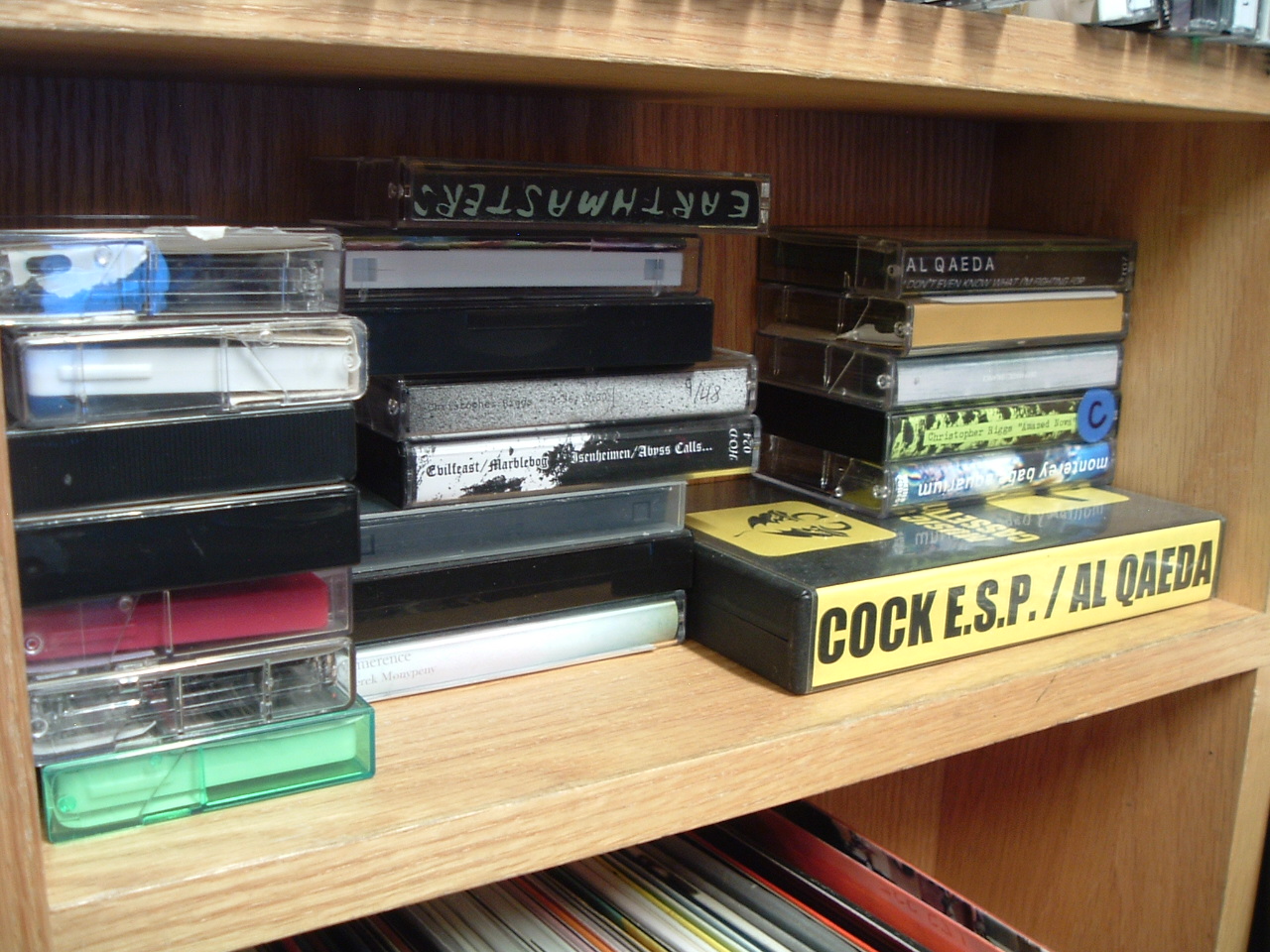
New cassettes at KFJC (Photo: J. Waits)
Social media outlets were abuzz yesterday with discussion about the ethics of stealing music after 20-year-old Emily White’s post, “I Never Owned Any Music Anyway” appeared on NPR’s All Songs Considered blog. In the piece, White, talks about how she has more than 11,000 songs in her iTunes library, but has only bought 15 CDs. The self-proclaimed college radio DJ explains that some of her music was taken from her college radio station. She writes:
“During my first semester at college, my music library more then tripled. I spent hours sitting on the floor of my college radio station, ripping music onto my laptop. The walls were lined with hundreds of albums sent by promo companies and labels to our station over the years. All of those CDs are gone. My station’s library is completely digital now and so is my listening experience.”
According to White’s bio at the end of her blog post, she’s the General Manager of American University’s online-only student radio station WVAU.org (although the WVAU website says that she’s one of the station’s Music Directors).
Although many are attacking White for stealing music (be sure to see David Lowery’s insightful rebuttal and my Radio Survivor colleague Paul’s excellent piece in response to that), I’m also interested in how this debate intersects with college radio and wonder about the ethics of copying music from a college radio station library.
I realize that it’s inevitable that college radio DJs will make copies of music found in their station’s library. And certainly this is preferable to outright theft. I’ve volunteered at stations over the years that struggled with the occasional bad apple record-stealing DJ. Less music seems to walk out the door of the station where I DJ than in the days before iPods and iTunes, so digital music piracy does seem to have cut down on the theft of physical music. That’s great news for a college radio station, but not necessarily good news for artists.
I remember a listener calling the station once to ask about a particular track that I was playing. After we chatted for awhile, the listener made a comment to the effect of, “Wow. I’d have the coolest iTunes library ever if I had access to the station’s library.” That statement irked me at the time and I am still bothered by it. Perhaps my annoyance comes from the fact that the caller was fixated on re-appropriating our station’s library. Why couldn’t the listener just enjoy the radio station as his source for amazing, hard-to-find music? Why did he feel the desire to “rip” our collection?
White also mentions that her college radio station no longer has CDs in its record library, that its collection is entirely digital. As a college radio participant and observer, I’m curious to know more about what happened to her station’s physical library. Were the CDs and vinyl digitized and then sold off? Were the records donated to DJs? What happens now when the station is sent promotional CDs? She concludes her post, saying,
“What I want is one massive Spotify-like catalog of music that will sync to my phone and various home entertainment devices. With this new universal database, everyone would have convenient access to everything that has ever been recorded and performance royalties would be distributed based on play counts (hopefully with more money going back to the artist than the present model). All I require is the ability to listen to what I want, when I want and how I want it. Is that too much to ask?”
Folks are attacking White for her attitude of entitlement (“what I want, when I want and how I want it”) and for her presumption that her entire generation isn’t willing to pay for music. Beyond that critique, I’m also saddened that as a college radio DJ, White isn’t understanding the ways that she is both hurting the artists that she loves, but is also discounting the very essence of radio.
White wants her music on demand, yet she’s apparently heading up an entire college radio station where whimsy and DJ-curated playlists should be the norm.
It also seems weird to me that a College Radio DJ/Music Director/General Manager would be someone who doesn’t buy physical music. White is missing out on some of the joys of college radio. I guess she never goes to record stores, never scans thrift store bins for hidden gems, and never goes to a merch table at a show to secure her own signed copy of her favorite band’s CD, record, or tape.
Speaking of cassettes, there’s a resurgence going on in the underground and artists are continuing to release material on tape. Although back in the day there were fears that “home taping” was killing the record industry, a return to vinyl and cassettes in 2012 may actually help to save the record business. If artists go the cassette-only route, they are rebelling against the digitally-oriented collectors. I’m guessing that the “I want it now” folks are unlikely owners of cassette decks and will likely be too frustrated by the complexities of digitizing a cassette to attempt pirating one.